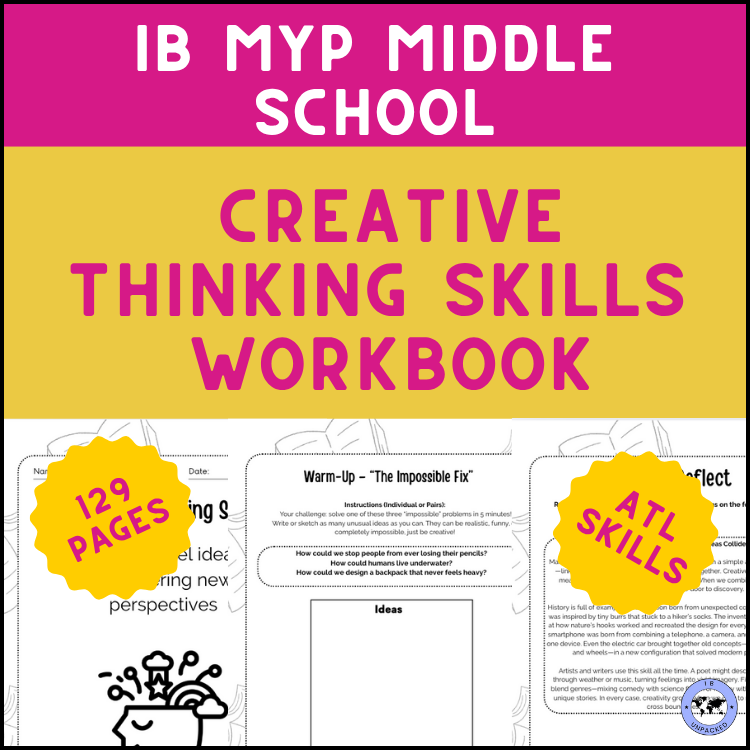
Creative Thinking Skills in the IB MYP: Helping Students Think Differently
If you’ve ever watched a student come up with an idea that surprises even them, you’ve seen creative thinking in action. In the IB Middle Years Programme, creative thinking falls under the Approaches to Learning (ATL) skill category of Thinking Skills. The IB defines creative thinking as generating novel ideas and considering new perspectives, and that definition really captures the heart of what we do as educators: inspire students to see beyond the obvious, explore possibilities, and innovate with confidence.
Below, we’ll explore each Creative Thinking subskill and share a simple, practical classroom activity idea for developing it.
1. Use brainstorming and visual diagrams to generate new ideas and inquiries
Brainstorming isn’t just listing ideas. It’s our invitation for students to think freely without the pressure of being “right.” Try giving your class a concept (e.g., identity, sustainability, or community) and have them create a mind map in small groups. Encourage wild ideas, doodles, and connections. By the end, you’ll see ideas blossom far beyond what they could have written in a linear list.
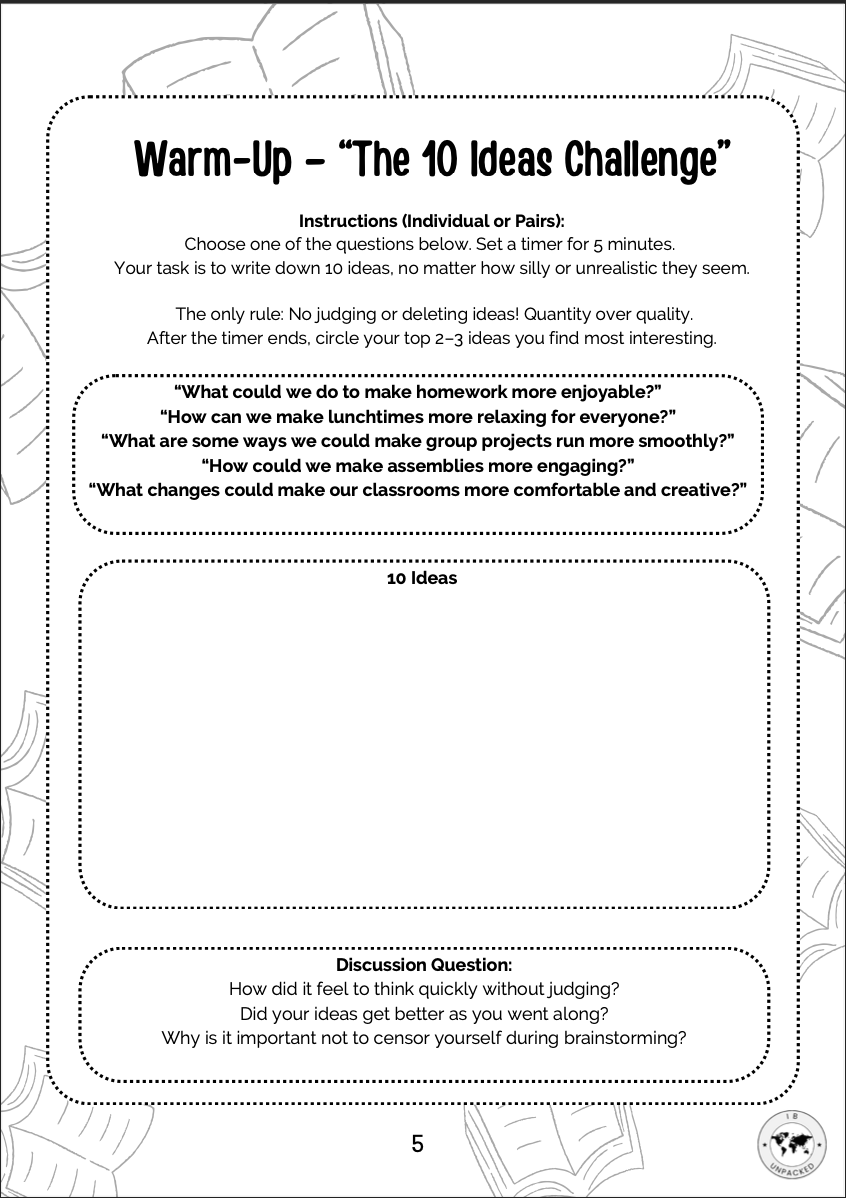
Here is an example from my Creative Thinking Skills Workbook: ‘The Ten Ideas Challenge’.
2. Consider multiple alternatives, including those that might be unlikely or impossible
This skill pushes students to move past their first idea. A fun activity is “The Impossible Solutions Challenge.” Present a problem, like “How can we travel to school on a floating island?”, and have students generate as many possible solutions as they can. Impossible ideas often spark new thinking that leads to surprisingly realistic innovations.
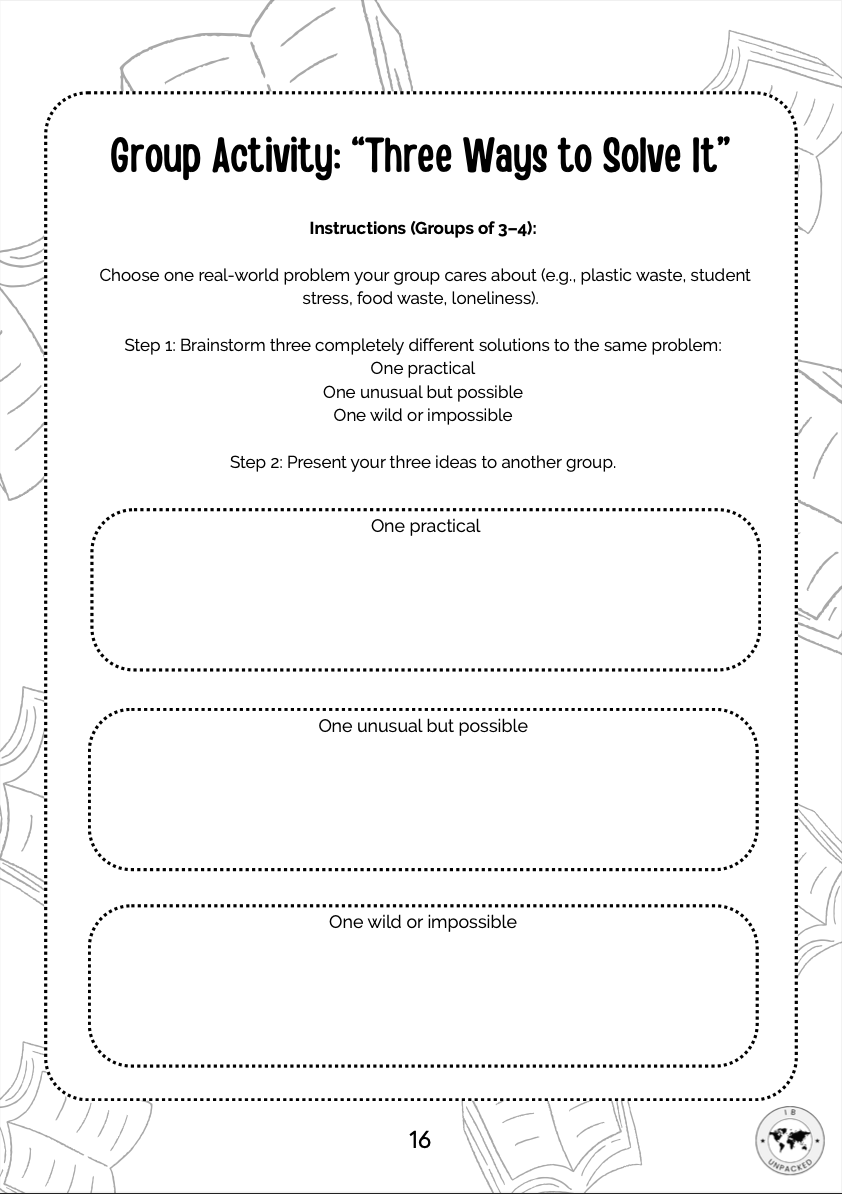
This activity really pushes students to go from the concrete and obvious, to the unlikely and impossible
3. Create novel solutions to authentic problems
Students love real-world relevance. Choose an issue from your local community, like trash reduction, water usage, or equitable recess spaces, and have students design a solution that could actually work. This could be a prototype, a proposal, or a campaign. Authenticity boosts motivation and creativity.
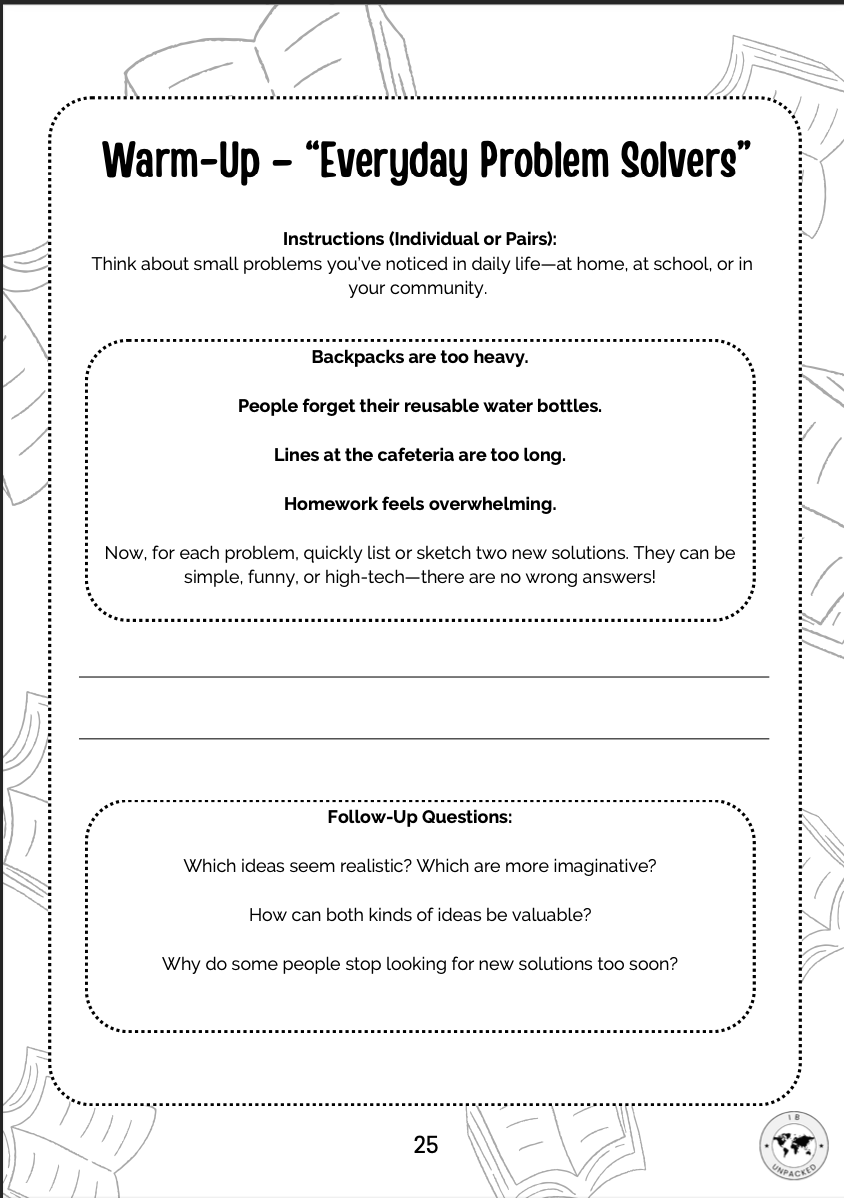
This activity keeps things relevant and focused on the local community for students.
4. Make unexpected or unusual connections between objects and/or ideas
Try a “Creative Fusion” activity. Give students two random objects or concepts (e.g., a violin and solar panel) and ask them to design something that combines both. This encourages playful reasoning and redefines what’s possible.
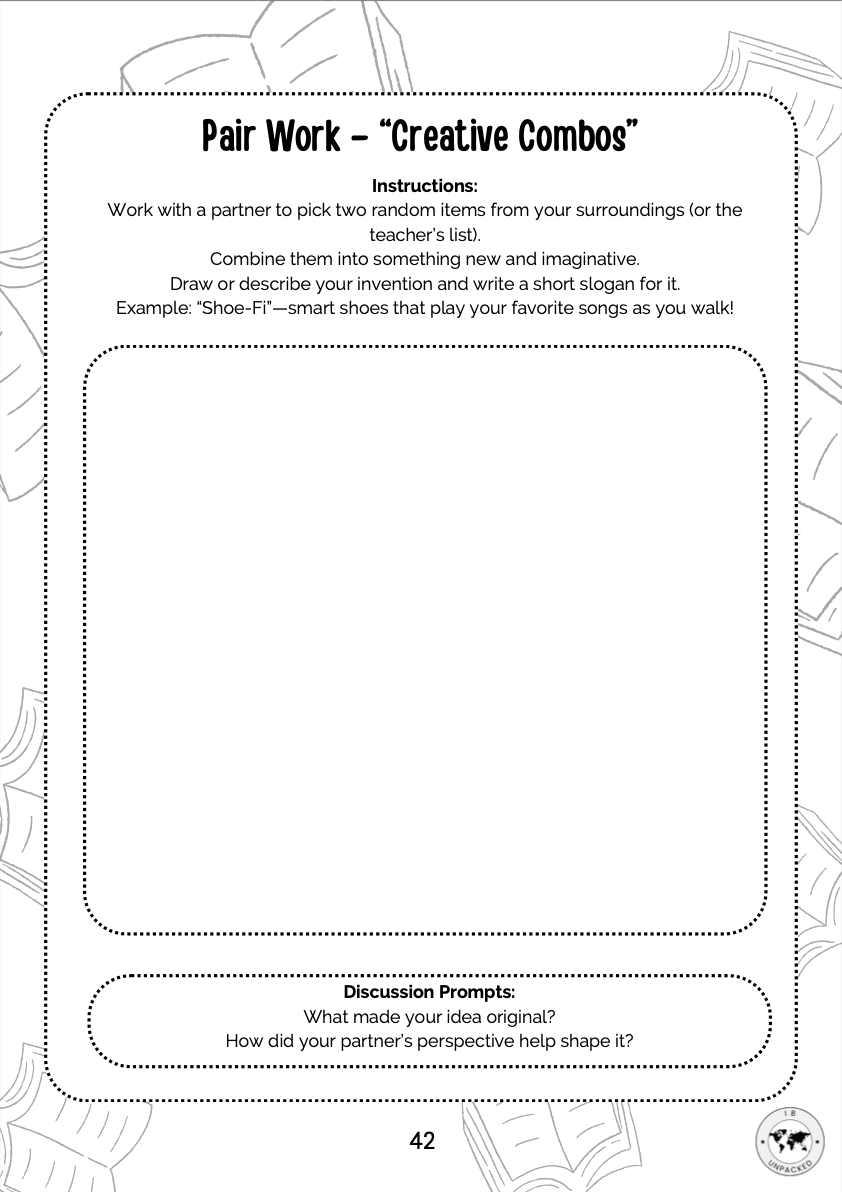
‘Creative Combos’ has students combining common items in their immediate surroundings. This is a great, creative-thinking warmup!
5. Design improvements to existing machines, media and technologies
Ask students to pick a device they use daily. Think of things like water bottles, lunch containers, earbuds etc., and identify one annoying flaw. Then challenge them to redesign the object with that improvement in mind. It’s a perfect entry point into design thinking.
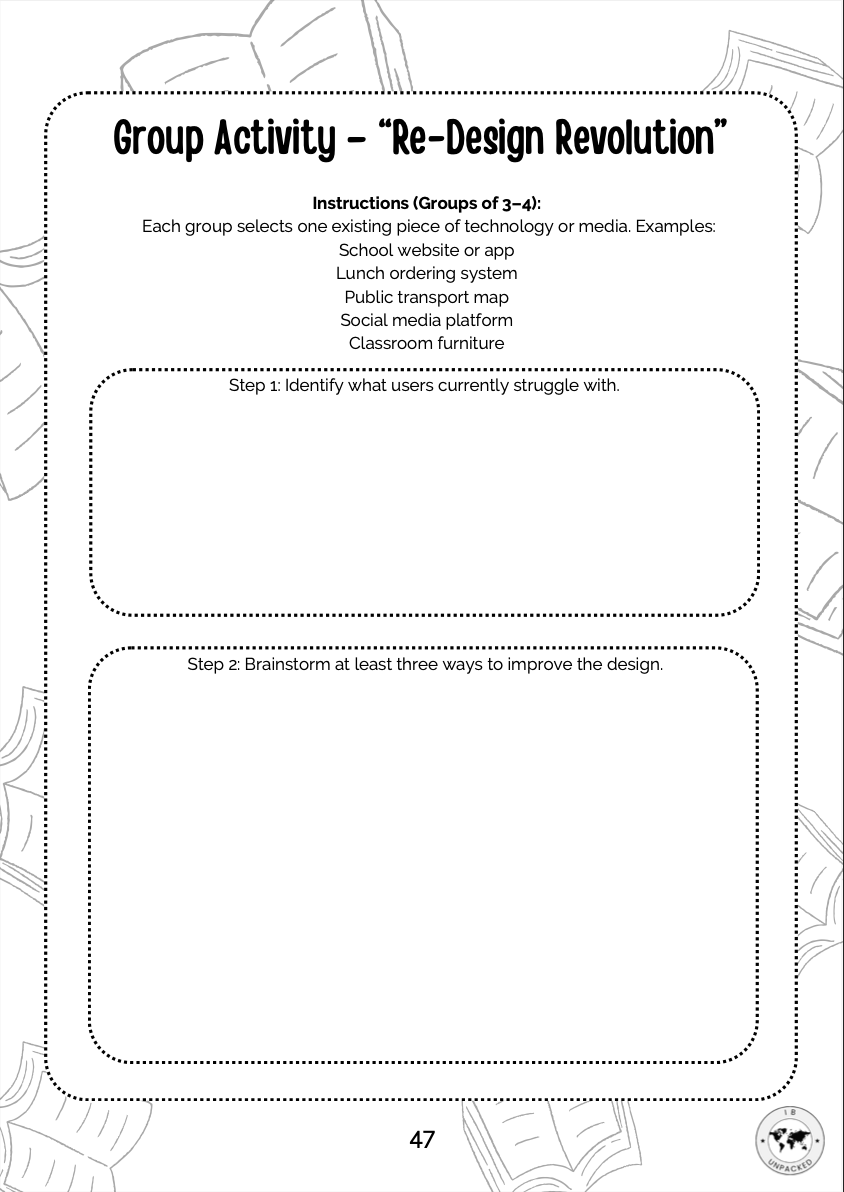
This activity has students redesigning systems in their lives that have flaws.
6. Design new machines, media and technologies
Go one step further and let students create something entirely new. Provide them with a simple prompt like, “Invent a device that makes someone’s morning easier.” Let them sketch, label, and pitch their design to the class.
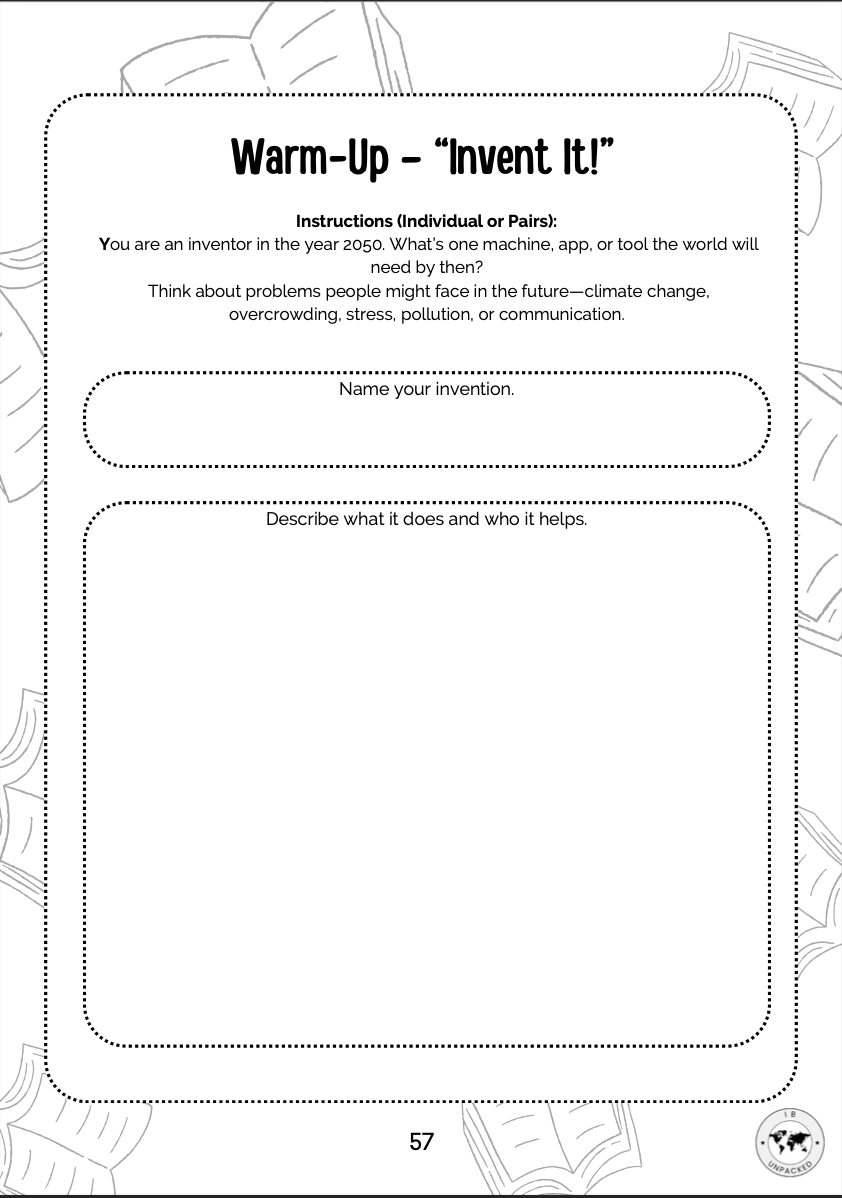
This activity has students imagining themselves in 2050, inventing a new product for their future selves and society. This is a fun one!
7. Make guesses, ask “what if” questions and generate testable hypotheses
“What if gravity worked sideways?” or “What if humans could only speak in song?” These questions make for an energetic warm-up. Then, connect the fun to a more academic context by having students form testable hypotheses in science- or design-based tasks.
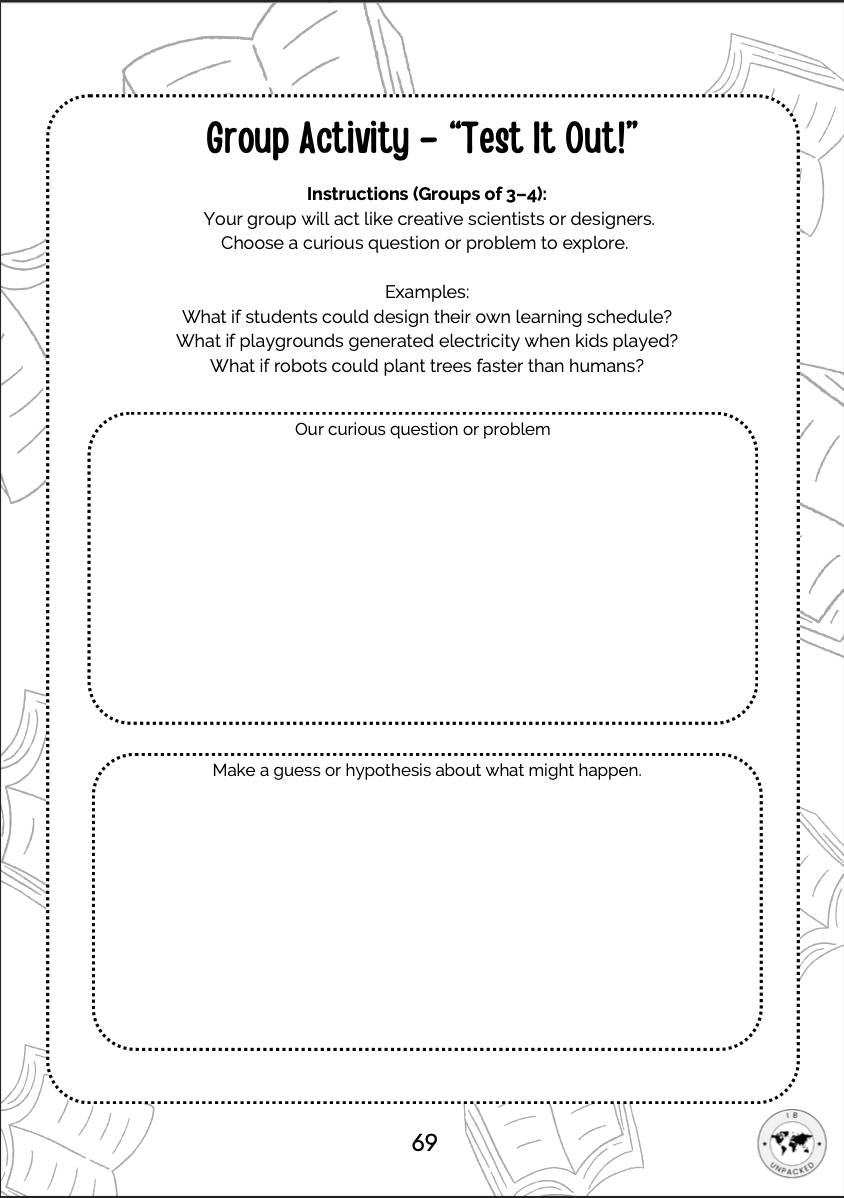
The second half of this activity has students designing an experiment to test their hypothesis.
8. Apply existing knowledge to generate new ideas, products or processes
Students often underestimate how much they already know. Give them a familiar topic, like storytelling structure or food chains, and ask them to reimagine it as a product (a game, an app, a comic, etc.). They’ll surprise themselves with how far prior knowledge can take them.
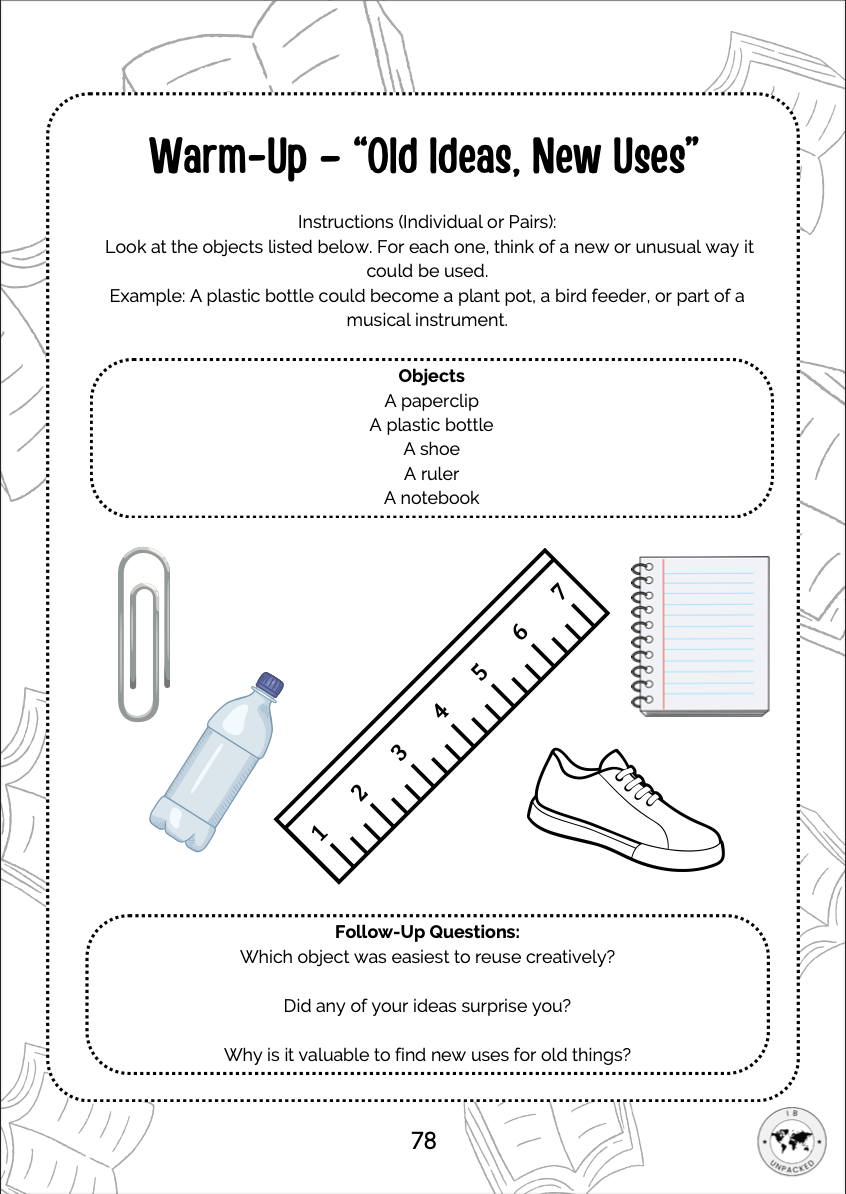
This activity has students thinking of ways to find new uses for old things. This is also a great activity for promoting environmental sustainability!
9. Create original works and ideas; use existing works and ideas in new ways
A remix project is perfect for this. Have students take a known story, artwork, or piece of music and reinterpret it in a different style, medium, or context. This skill celebrates creativity and respect for existing artistry.
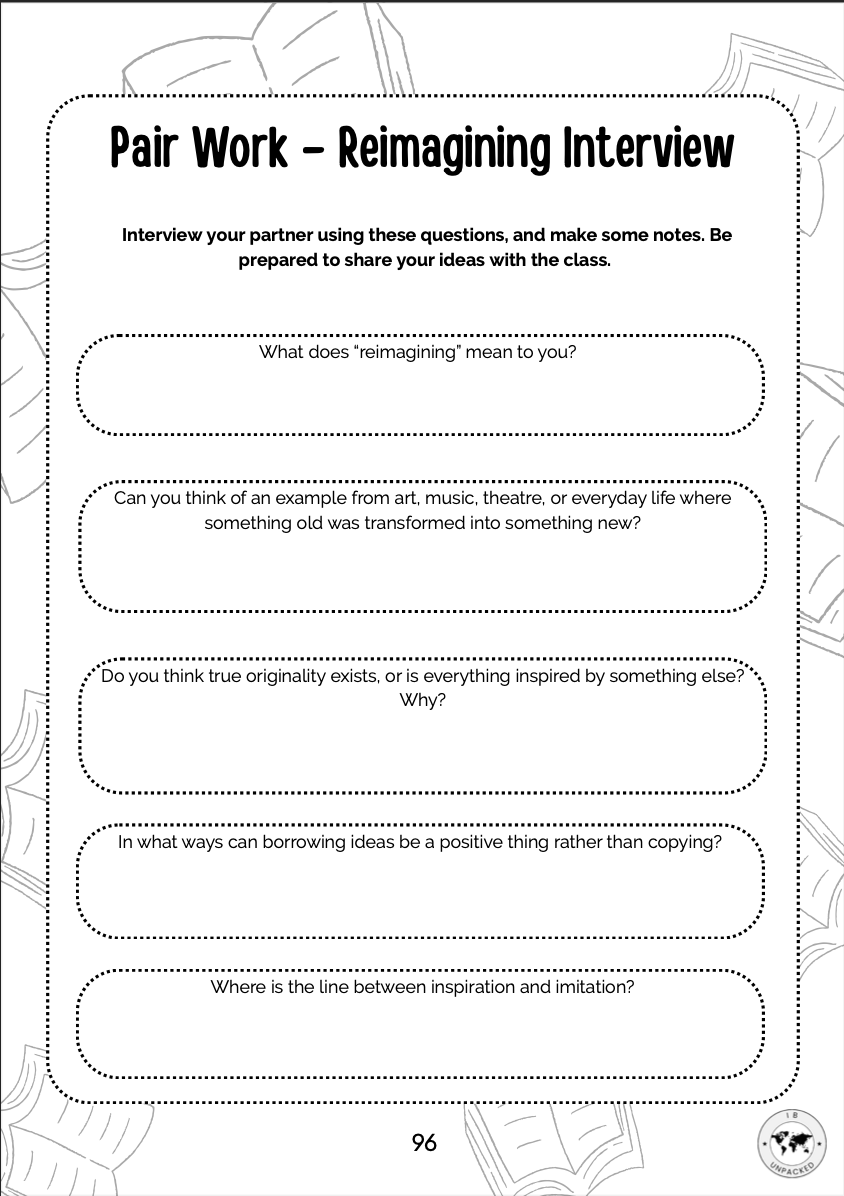
This lesson involves a pair interview task, diving deep into the concept of ‘reimagining’, and giving lots of opportunity to rich reflection.
10. Practise flexible thinking—develop multiple opposing, contradictory and complementary arguments
Try a structured debate where students must argue both sides of an issue. After debating one side, switch roles halfway through. It’s a powerful way to strengthen empathy, reasoning, and adaptability.
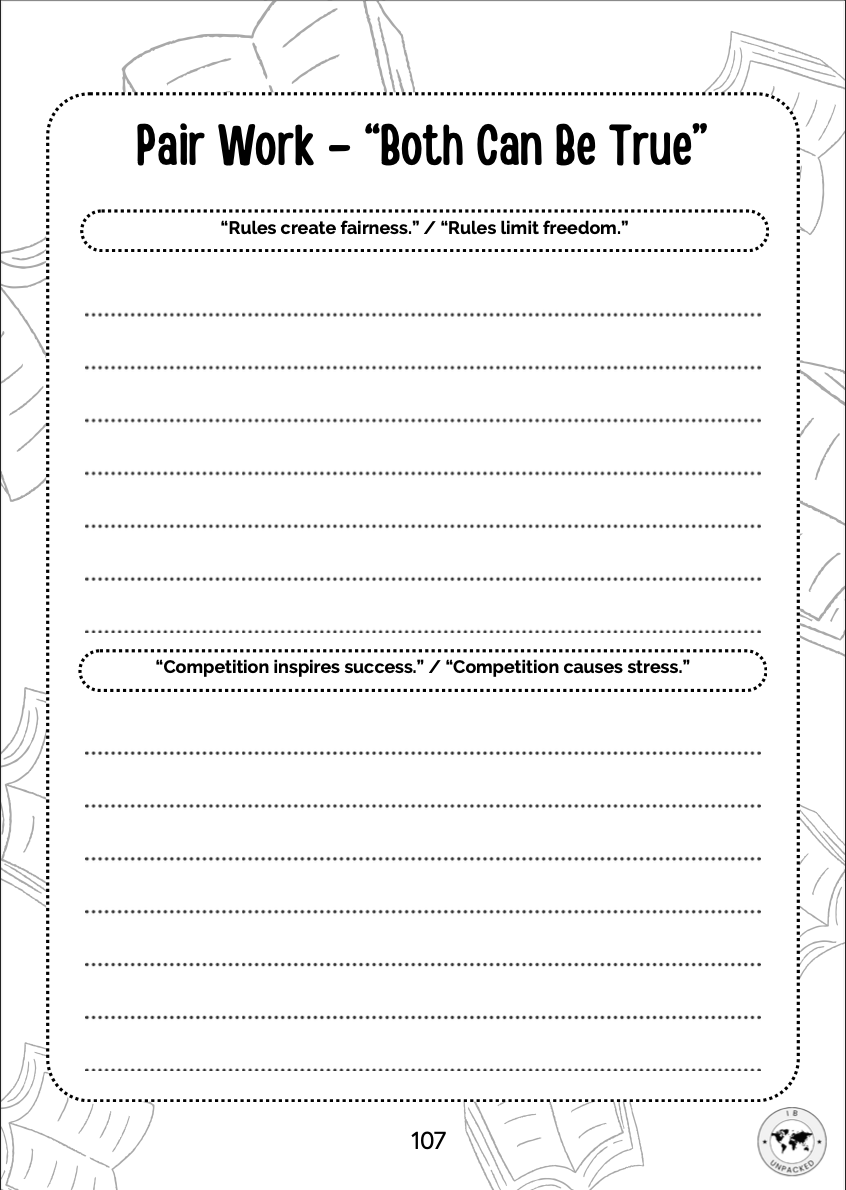
In this activity, students have to develop arguments for both sides, and explain how both things can be true.
11. Practise visible thinking strategies and techniques
Use routines like “See—Think—Wonder” or “I Used to Think… Now I Think.” These simple reflection tools make the thinking process explicit and build metacognitive awareness—an important foundation for creativity.
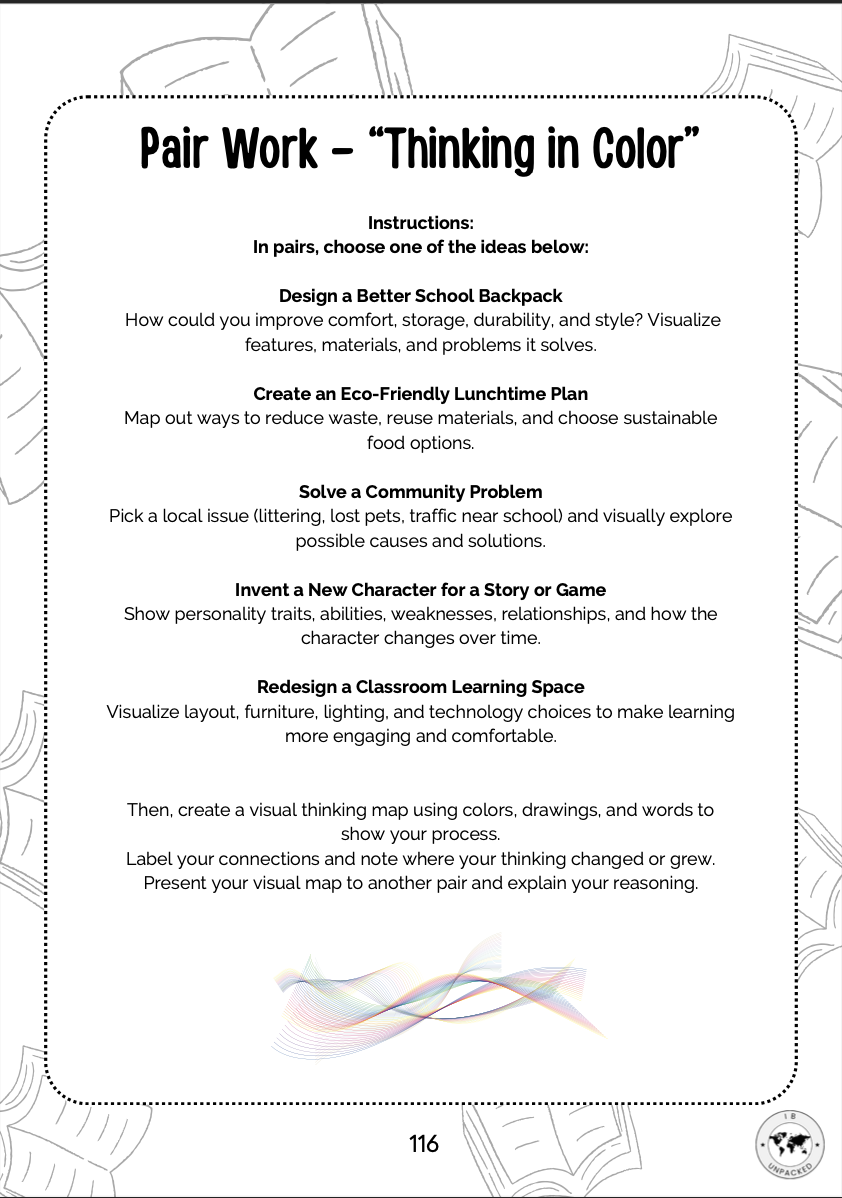
This activity promotes the idea of ‘thinking in colour’, and practising visible thinking strategies.
12. Generate metaphors and analogies
Have students compare a complex idea (like justice or energy) to something unexpected (chocolate, thunderstorms, rivers). Metaphor-making forces the brain to stretch and find deeper layers of meaning.
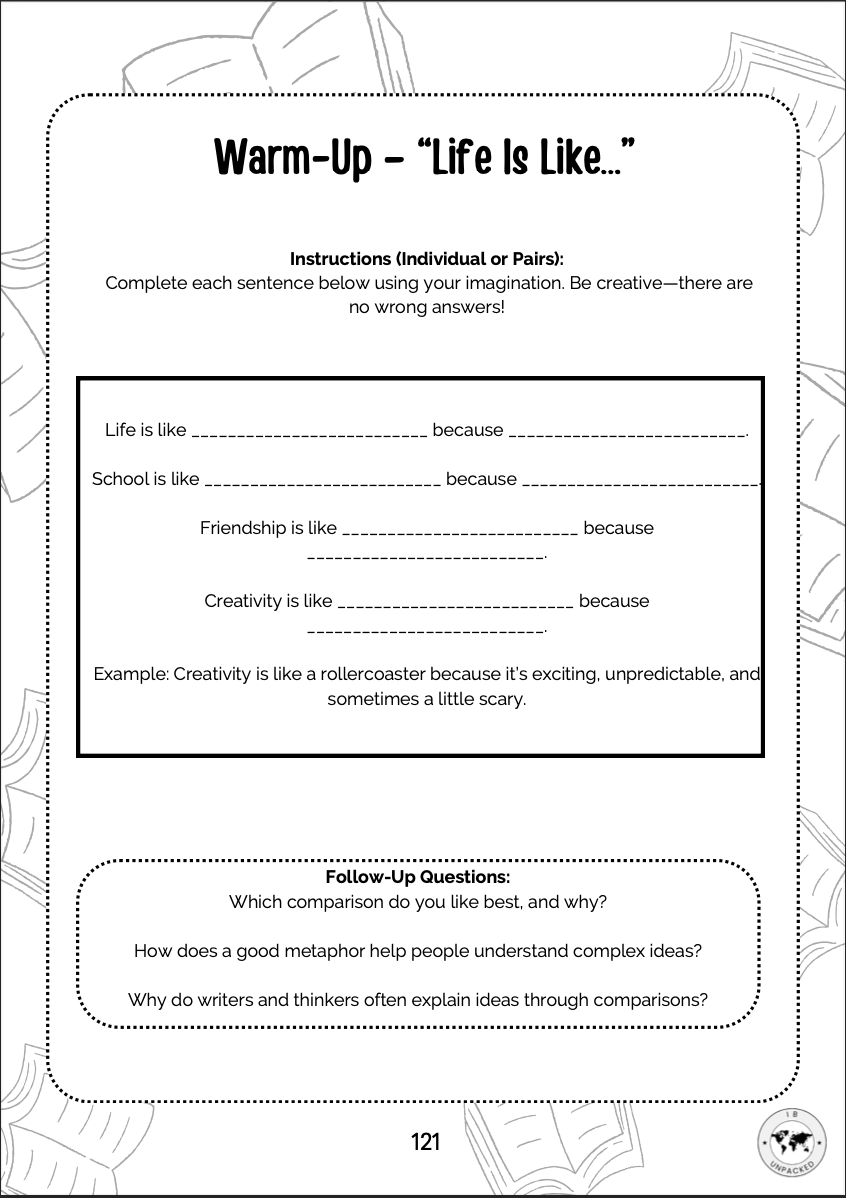
The language and literature teachers will love this one!
Want Ready-to-Use Lessons for Each Creative Thinking Subskill?
If you want to teach these skills with ease, and you liked the look of the activities that I posted above, then check out my Creative Thinking Workbook for IB MYP teachers. It includes 12 complete, no-prep 1-hour lessons—one for each sub-skill above. Each lesson is student-friendly, inquiry-driven, and ready to print or project. It’s a perfect resource for boosting ATL integration in your classroom while saving you planning time.