Finding Their Voice: Teaching and Assessing Speaking in the MYP
If there’s one skill that truly brings a language to life, it’s speaking. Watching students grow from hesitant word-by-word responses to confident, spontaneous conversations is one of the best parts of teaching MYP Language Acquisition. But what does “speaking” actually mean in the MYP context, and how do we teach and assess it effectively?
Let’s dive in.
1. How Speaking is Taught
In the MYP, speaking is about communication with purpose. Students don’t just practise isolated dialogues, but they interact using the target language in meaningful, real-world ways.
That might mean discussing a local issue, interviewing a classmate, or recording a podcast about their favorite hobby. The focus is on authentic communication, and on using language to share ideas, express opinions, and respond naturally.
Teachers support this by designing speaking tasks that encourage interaction, not recitation. The idea is to help students develop the confidence to use language spontaneously, even when they make mistakes. After all, fluency grows from risk-taking, not perfection.
2. How Speaking is Assessed
Speaking is assessed using Criterion C, which focuses on how well students:
Use spoken language to communicate and interact with others
Demonstrate accuracy and fluency
Communicate clearly and effectively in context
Students are evaluated according to their proficiency phase: Emergent (1–2), Capable (3–4), or Proficient (5–6). The expectations rise gradually, from basic exchanges using familiar phrases to nuanced discussions where students justify opinions or express complex ideas.
Assessment tasks might include role plays, interviews, class discussions, or presentations, which are often supported by visual or written prompts to give context and purpose.
3. The Role of Multimodality
The MYP sees communication as multimodal, which means that speech often happens alongside visuals, movement, and digital media. So, when students record a vlog, participate in a debate, or present slides in the target language, they’re practising not just speaking but also communicating meaning through multiple modes.
This approach mirrors how we communicate in real life, which blends tone, gesture, visuals, and digital tools to make meaning clear.
4. Fluency, Accuracy, and Confidence
A key goal in MYP speaking is to balance accuracy (correct use of grammar and vocabulary) with fluency (natural flow and expression).
In early phases, we celebrate effort and the willingness to try new phrases and take risks. As students move up through the phases, we focus more on pronunciation, intonation, and the use of appropriate structures for context and audience.
Confidence-building strategies like pair work, rehearsal time, and feedback circles are invaluable. When students feel safe experimenting with language, fluency blossoms.
5. Culture and Connection Through Speaking
Speaking tasks also help students build intercultural understanding. Discussing traditions, sharing opinions, and exploring cultural similarities or differences all deepen both linguistic and cultural awareness.
Encourage students to use the target language to talk about their own world, including their community, school, or interests, while making connections to the cultures where the language is spoken. This makes communication authentic, personal, and meaningful.
Final Thoughts
Speaking in the MYP isn’t about perfect pronunciation or memorized scripts. It’s about giving students a voice in another language.
As MYP teachers, our role is to create spaces where students feel empowered to communicate ideas, make mistakes, and keep trying. Because every time they speak, whether it’s a simple greeting or a full debate, they’re building the courage and competence to connect across cultures.
So get those students talking! Record podcasts, debate topics, act out scenes, or host a mini “language café.” The more they speak, the more they’ll grow linguistically, socially, and globally.
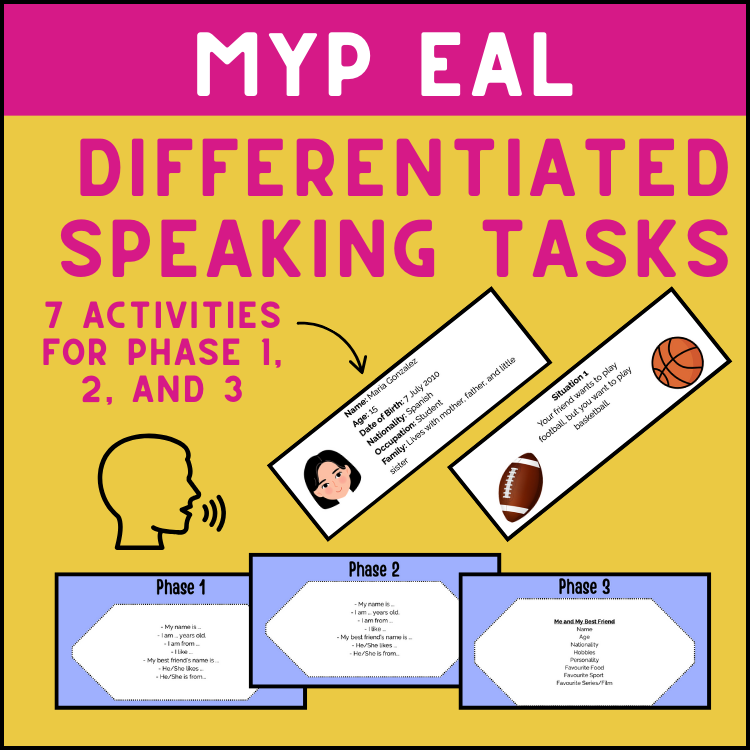
If you want to try an example of authentic, differentiated reading, check out my speaking resource about ‘Friendship’, for Phase 1, 2, and 3.
