Why I Love Project-Based Learning
I’ll be honest. Once I properly embraced Project-Based Learning (PBL), I never looked back.
There’s something incredibly powerful about watching students move from passive learners to active creators. The energy shifts. The ownership shifts. And suddenly, the classroom feels less like a place where information is delivered and more like a space where ideas are built.
Here are five reasons why I truly love Project-Based Learning and why I believe it prepares students for the world they’re growing into.
1. It Builds Real-World Skills
Project-Based Learning mirrors real life.
In the adult world, we do not complete worksheets. We solve problems, collaborate, research, create presentations, meet deadlines, and adapt when things do not go to plan. PBL gives students the chance to practise all of that now.
Through projects, students develop:
Collaboration and teamwork
Communication skills
Time management
Problem-solving
Research and critical thinking
These are the exact skills universities and employers consistently say they value most. PBL does not just teach content. It teaches capability.
2. It Encourages Deep Learning
When students complete a project, they cannot simply memorise and forget.
They need to understand.
They need to apply.
They need to create.
Instead of asking, “Will this be on the test?” students start asking, “How can we make this better?” That shift alone tells you everything.
Project-Based Learning encourages inquiry, deeper questioning, and meaningful connections between ideas. Students retain more because they are actively constructing knowledge, not just receiving it.
3. It Builds Confidence and Ownership
One of my favourite moments in PBL is presentation day.
Students who may not always shine in traditional settings suddenly light up when they are sharing something they have created. There is pride. There is excitement. There is genuine ownership.
When students make choices about format, research direction, creative elements, or problem-solving approaches, they feel responsible for the outcome. That sense of ownership builds confidence in ways a worksheet never could.
And confident learners take more risks.
And risk-taking is where real growth happens.
4. It Makes Learning Relevant
Students constantly wonder, even if they do not say it out loud, “Why are we learning this?”
Project-Based Learning answers that question naturally.
When projects connect to real-world issues, authentic audiences, or meaningful problems, learning becomes relevant. Whether students are designing solutions, creating campaigns, researching global issues, or presenting proposals, they see purpose behind the content.
Relevance increases motivation.
Motivation increases effort.
Effort increases achievement.
It is a powerful cycle.
5. It Prepares Students for the Future
The world our students are entering is changing rapidly. Automation, AI, global collaboration, and innovation are reshaping careers in ways we cannot fully predict.
What we can predict is that students will need to:
Adapt
Think critically
Communicate clearly
Work with diverse teams
Solve complex problems
Project-Based Learning nurtures exactly those capacities.
Rather than training students for a specific test, PBL prepares them for a dynamic future, one that values creativity, resilience, and initiative.
Final Thoughts
Project-Based Learning is not always the easiest approach. It requires planning, flexibility, and trust in the process. But the payoff is worth it.
When students are engaged, challenged, collaborating, and creating, that is when learning feels alive.
And that is why I love it.
Project-Based Learning in My Own Classroom
If you have been following my teaching journey for a while, you will know that Project-Based Learning is not just something I talk about. It is how I design my units.
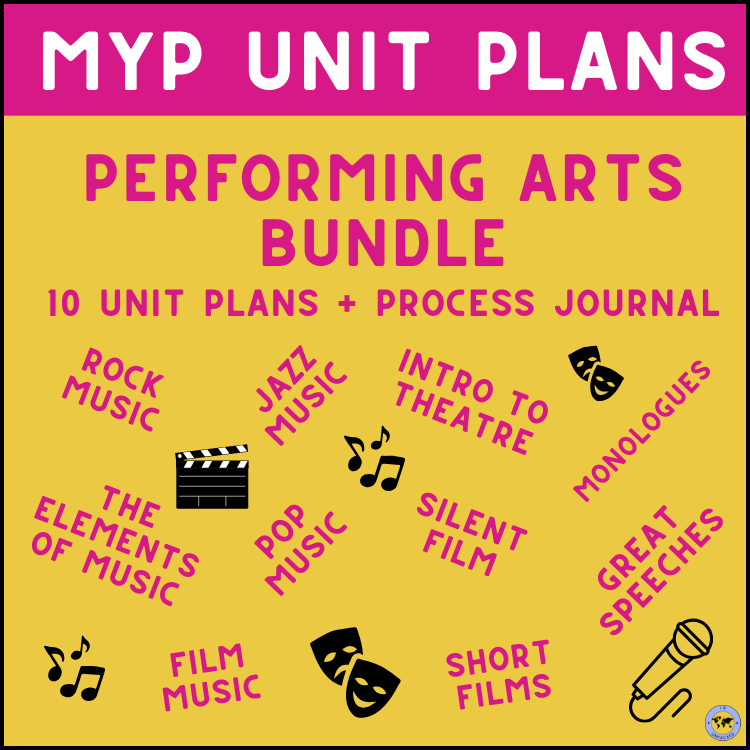
Every one of my Performing Arts units is built around a meaningful, authentic project.
For example, in Film Music, students do not simply study the elements of film scores and complete a worksheet. They actually compose original music for a film scene. They analyse, experiment, revise, and then produce a finished composition that matches mood, character, and narrative. The learning is applied, creative, and deeply engaging.
In Short Film, students do not just watch examples and answer comprehension questions. They plan, storyboard, film, edit, and present a complete short film. They experience the full creative process from concept to final screening. Along the way, they develop collaboration skills, technical confidence, time management, and creative problem-solving.
These are not “end of unit tasks.” The project is the unit.
Over the past 10 years, I have refined and taught these MYP Performing Arts units in real classrooms. I have seen how powerful they are for engagement, ownership, and skill development. Students rise to the challenge when the work feels authentic and purposeful.
If you are looking to bring more Project-Based Learning into your Performing Arts classroom, my MYP unit plan bundles are designed to help you do exactly that. They provide structure, clarity, and real-world creative outcomes without losing academic rigour.
Project-Based Learning has transformed my classroom. These units are the result of that journey.